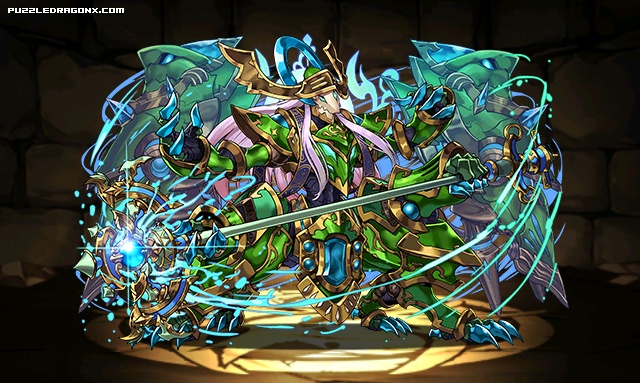
I've largely held back on buying Yomidra due to never rolling Eschamali, and that a 36x sparkles lead wasn't too interesting to me at the time. However, Gremory is receiving a buff to include God typing into her LS, so I told myself why not? I have lots of MP laying around anyways. Yomidra is capable of some really consistent damage, and is relatively strong with the Suvo she will be getting sometime this week. Not to mention, you don't have to limit yourself to using dark subs only, as demonstrated by Reco here.
SUBPOOL: God typing to receive the leader skills buffs. As mentioned above, it is not necessary to go on color with Yomidra to deal consistent damage, but a dark focused team is what you want to go for. Subs with both OE+ and TPA can also be useful if you have the orbs, and as long as you can guarantee an OE+ drop it will work.
POTENTIAL: 5 OE+ match is a board I don't usually play, but it is pretty simple to get used to. Yomidra isn't as difficult to play, especially since her damage is quite efficient and consistent. A higher level player will get a lot of use out of Yomidra, whether it be for speed clears of dungeons or easy dungeon spams. It may be difficult for Yomidra in A3 since she has no HP multiplier, but with the right inherits and setup it should be feasible. Otherwise, Yomidra has some really quick clears for content like A1 or similar difficulty dungeons.
EFFICIENCY: A single firework is all Yomidra needs to deal consistent damage. Combined with added combos, it shouldn't be difficult for Yomidra to always have 5 relevant orbs on the board. Her best sub Eschamali can guarantee additional skyfalls to increase efficiency, and as long as there is 1 enhanced orb on the board you can activate. Yomidra herself will supply 4 dark orbs as well if needed, so it is pretty easy to always get an activation. You should only get into a bind if you get full board changed like Beelzebub, but you could always take an active to deal with it.
STABILITY: No HP multiplier, but Yomidra supplies an all important row heart on an unbindable base. She also can provide 4/6 hearts for that row heart, so she can serve as a soft bind clear if needed. Aizen and Meri have proven that no HP leads can be viable, as long as they can deal high consistent damage. While Yomidra doesn't have the ease of use of those leads, she should still be highly competitive in endgame content.
Showing posts with label leader analysis. Show all posts
Tuesday, February 28, 2017
Sunday, February 26, 2017
Leader Analysis: Anaphon
Poor Typhon gets pushed to the back for a cute grill to take the spotlight. Anaphon is a good mix between Gremory and Myr, with a more restrictive subpool. With the right subs, Anaphon can be a very stable leader for high end content.
SUBPOOL: The subpool for dark dragon or balanced typing is not very wide. Aside from 6* GFE Gremory and MP Purchases Xin Hua and Yomidra, there are few subs that offer double orb create, with Lead Akechi being the most useful here. The team would be more dependent on SI for orb change, or use single orb changers with orb stalling using Anaphon's good stability.
POTENTIAL: The restrictive typing makes Anaphon hard to approach as a newer player, but veteran players with well developed boxes may find the subs to run Anaphon. Ana can do very consistent damage, and it should be enough for Arena 1 to sweep the later floors. She may lack the damage for content higher than that though, due to lack of OE+ like Myr or the high row multiplier of Gremory.
EFFICIENCY: Like most heart cross leads, Anaphon has varying orb efficiency based on your team setup. Anaphon can be ran with Rows or TPAs, and the stronger your team is the less orbs you should need to deal high consistent damage. Anaphon also brings a board change, but quad color boards are not as good so you will want some way to fix the board (Akechi also turns Anaphon board into a bicolor)
STABILITY: Ana has an HP equivalent of Myr when having the heart cross, but also has an HP multiplier if a heart cross cannot be made. An addition, Anaphon is unbindable and brings a Row heart to unbind the team if needed. The team may be lacking in RCV, so you will want to take as few unshielded hits as necessary.
Thursday, February 23, 2017
Leader Analysis: Myr
The great meta killer. Cross leads in general were a pretty good way to increase gameplay mechanics, but the prevalence of heart cross shields drastically changed the meta to high tank builds. Newer leaders are incorporating damage resistance into their LS as a way to be comparable to heart cross, but heart cross remains a strong way to have stability built on orb matching. After taking a long time to getting used to making heart crosses, it is pretty fresh to run leads that don't need awkward match setups.
This analysis will include the normal review I usually do, plus the comparisons between light and water Myr.
SUBPOOL: Myr can be ran with TPA or Row subs, which allows for high flexibility and variable damage control based on what subs you are bringing. Myr covers a lot of utility, such as guaranteed OE+, unbindability, four seconds of time extends, and the shielding. The subs will want to support consistency to create the heart cross while being able to support their weight on the team. Heartbreakers or board changers with no hearts are not recommended, unless you inherit over them or can fix that board.
POTENTIAL: The extra time extends and increased stability are great for lower players, and remains very strong for higher end dungeons. Although the damage multiplier slightly threw off her damage control for Sopdet and Parvati, the added boost in damage helps in the more difficult dungeons. With the proper setups and skill, Myr can power through the hardest content.
EFFICIENCY: The stronger your team is, and based on what orb match route you take, Myr varies on efficiency. While you always need a heart cross to do damage, stronger teams can often tank hits during a orb clear turn, and then recover from the next turn with a heart cross. For damage though, you will often want rows to fully increase the team's damage, or TPA and high combo for more TPA based teams.
STABILITY: Heart cross allows Myr to tank the most ridiculous of hits. While you need to match that cross to get that stability, it is well worth the damage reduction. Taking less damage and then requiring less RCV is very nice, while the unbindability of Myr means you can always heart cross provided you have the orbs.
COMPARISON
It has probably been known that light > water due to no element weakness, but both have its strengths.
The list of subs goes on from single orb changers, bind clears and such. Obviously you can cover a lot of skills through inheritance, but this is just a taste of base subs available. In general, light has the better bicolors and double orb subs, but water has the better utility and luxury bases. Your mileage will vary depending on what your box offers, but the larger selling point is that light Myr is farmable. Summyr is "farmable" in a sense and is only available during a collab.
My choice is light Myr simply because it is more readily available to other players and does not involve a collab exclusive leader, but Summyr has those nice utilities to tap into. Gungho is looking into methods to dethrone heart cross, so the outlook of Myr dominating the tiers may be just over the horizon, but in no way does this mean that Myr becomes weaker. This only means that more leaders can be post endgame reliable and Myr can retain her strength.
Tuesday, February 21, 2017
Leader Analysis: Mega Ultimate Chicken
Starting with the Uvo:
SUBPOOL: (YOU DONT HAVE THE SUBS) Radra's sub pool is large according to the wide encompassing of God typing, but the good subs that you can use for Radra that do not break the board are very small. The current subs that do not come from GFE are small, and the core of Radra teams come from 6* GFE DKali, a B/G sub that is unbindable like Isis, and a double SBR sub to prevent skill binding.
POTENTIAL: A lot of the content has changed since Radra's release, and the hard difference in damage control from 9x to 64x barred Radra from higher content. Bad orbs and mechanics also make fully activating Radra more difficult, and absorbs and nulls severely limit how strong you can match. In addition, the meta shift has caused a lot of content to be more difficult for Radra to easily clear, and other leaders are better chosen for those dungeons. Newer players should stay away from Radra, both as an MP purchase and as a leader until they have the box to support Radra and the matching skill to fully activate Radra consistently.
EFFICIENCY: Needing all orb types to fully activate and only matching five out of six types for a weaker multiplier isn't the greatest. Stalling and clearing extra orbs to hope for a proper board works, but lack of an HP multiplier makes it risky in some cases, or dependent on having a shield on the team to survive such hits. Having a full board change ready helps in moving faster, but that will require you having the skill on the team. (Having the proper subs is important to do so)
STABILITY: A RCV multiplier and being unbindable is great, but in today's meta, having more HP bulk is important for surviving the larger hits in higher content. The proper team is fully unbindable, and you cannot get color locked, which is an absolute bonus for any rainbow team.
Suvo:
SUBPOOL: Same as above. The difference being the Suvo has an SBR so a double SBR sub isn't necessary anymore.
POTENTIAL: Easier match requirements similar to Roots makes Radra more approachable, and continues to reward higher skilled players with consistent full activation. Radra can clear endgame content much more simply due to this, and makes earlier game content a lot easier.
EFFICIENCY: Not needing all orbs makes Radra sweep a lot of floors more easily. The difficulty of 9x being too weak and always needing 64x is gone, as the 25x multiplier with prongs is still strong enough for easier floors, and thus helps with speed and not needing a board change for safety.
STABILITY: Suvo Radra received the all important HP multiplier, bringing the effective HP to slightly less than a 35% heart cross shield. The difference here is not needing the heart cross, so matching is more baseline. Continuing to not need bind clear and bringing a shield to safely tank the more dangerous attacks in solo make Suvo Radra so much more stable.
In short, the Suvo covered the main weaknesses of Uvo Radra, and makes Suvo comfortably
Monday, February 20, 2017
Leader Analysis: Meridionalis
Since Meri's release in JP, she quickly dethroned ALB as a primo farming leader in terms of damage and speed, with the exception of a slightly more difficult to obtain subs. Aside from farming, Meri has a very strong row multiplier comparable to Sarasvati without the orb hunger, and a strong RCV multiplier to support her stability.
SUBPOOL: Since Meri does not have an SBR, a double SBR sub like Andromeda is necessary. However, water has a lot of water row subs. TPA subs are less strong due to Meri needing a hero row, but higher water boards may be able to fit TPAs in addition to the hero row. The new split Blodin serves as a luxury sub and inherit base, but the SBRs are still an issue when not in coop.
POTENTIAL: Meri has very good damage, control, and no skyfalls is a blessing in many cases. Aside from combo shields being slightly difficult, Meri's active covers that weakness and damage absorbs can be worked around and planned through no skyfalls. Players with higher skill can orb save well for bigger burst, while earlier players can be taught how to combo better.
EFFICIENCY: Hero boards are quite expensive when it comes to orbs, but Meri does plenty of damage with a row of six. You can clear quite a lot of things with just that row, and very little can stand against the full multiplier of Meri. However, being unable to activate with under 6 orbs is a problem, but stalling with her great RCV is a great option.
STABILITY: No HP multiplier and bindable is a large issue, but Meri has a great stall game as long as there are hearts. You will want to find bind clear to help with bindability, and a lot of high HP subs to tank hits. A heartmaker will also be useful to stall since no skyfall means strict board work.
Wednesday, February 15, 2017
Leader Analysis: Shiva
Shiva is part of one of the earliest pantheons in the game, and has come quite a long way since. His defense void skill was very useful a long time ago, and though nowadays it is less powerful, his reincarnation has given him some new life. Combo leads are always fun to play.
SUBPOOL: Fire subs with TPAs are the best subs here. Shiva already supplies a couple of OE+ so you will want a sub to cover the last one, and then fill out from there. Row subs are less optimal, but as long as the skill is good it will work. In this age of inherits though, it is better to just inherit that skill on top.
POTENTIAL: Combo leaders are great for learning to play, and high end players should be able to fully activate Shiva all the time. Shiva does very good mid range damage, and fire TPAs with OE+ can do a lot of work. Stacking more fire TPAs help a lot with higher end dungeons, and a good active will certainly let you always activate.
EFFICIENCY: Like Bastet, you can use just a fire TPA and combos to maximize board use and get good damage. The better your board clear, the better orb efficiency and consistency get. Hitting max combos will usually let you sweep most floors for content that Shiva is good in.
STABILITY: RCV will help a lot in recovery, but being bindable and no HP multiplier makes the post endgame dungeons more difficult. Standard utility for this kind of team applies, such as bind clear, a heartmaker for safety, and a shield for some of the larger hits.
Leader Analysis: Aizen
Very late to write an article on, but I felt like I should cover it anyways.
In a meta where heart crosses and tank teams dominate, Aizen has blindsided the meta and proved that glass cannon leads are quite viable, provided they have the ease of use and stability that Aizen has. Aizen is so strong that many would consider him to be broken, and I hope that Gungho learns from this to balance their new cards first before giving them unreasonable buffs.
SUBPOOL: Dark subs only. Water with dark sub attribute can work as well, but you can also skip the water sub attribute on dark cards since the RCV is already really good. It is hard to find a dark card that does not work on Aizen, save for playing Rowzen and giving people the memes.
POTENTIAL: Tons of damage, and can even do very well without skills. Aizen is already an unconditional 36x before matching a cross, sweeps most floors with one cross, and always sweeps on two crosses. Aizen also fairs very well in higher tiered content, provided you can support his no HP multiplier. Players low and high can find lots of use in Aizen from speed clearing to content clears.
EFFICIENCY: Unconditional 36x is hard to pass up, and can also lead to great damage control. You can use water matches to lower damage, match darks or TPA darks and combos to increase efficiency, and a cross is often enough for most content. Double crosses are seldom used, but you should know when you need them.
STABILITY: No hp multiplier, but a good RCV multiplier, being unbindable, and can unbind the team is a great plus. Most things come down to "do I have enough HP to tank", and otherwise it is pretty hard to stop Aizen. Since he is so efficient, it is highly recommended to take utility instead of orb creation to cover some of the harder floors of A3, but for most content your HP pool should suffice, granted you aren't attempting content out of your progression.
Tuesday, February 14, 2017
Leader Analysis: Gremory
Dark rows have always been my preferred team and playstyle, and it makes writing this very hard to be unbiased. Still, a high damage multiplier combined with rows is formidable, and I don't regret going for this harder pull. Even as she slowly slides down the tier lists, she is still a very strong and capable leader.
SUBPOOL: Though balanced typing is an odd choice for dark rows, the inclusion of devil subs (and soon gods) makes it really easy to find a suitable sub. You will want prime dark/heart double orb changes like Pandora or Akechi, but single orb changes are good as long as they do not break hearts. The strongest subs to make Gremory shine are gated by REM though, and include MP purchases Xin Hua or Yomi Dragon(after buff) as good sub choices.
POTENTIAL: The typing restriction is a little difficult for newer players, but more developed boxes can fully take advantage of Gremory's potential. 144x with rows is a very strong multiplier, and can often sweep most floors with ease. However, strict combos and dark matches are necessary on resolve or damage absorb floors, and getting skyfalls can be quite problematic. Players will need to know where they can stall comfortably to keep actives ready, and plan them ahead to consistently activate her leader skill.
EFFICIENCY: For more developed teams, you can often get away with multiple dark matches instead of rows if you use a skill. However, when not using a skill, the board requires more manipulation or many favorable orbs to sweep. Haste actives with orb creation can alleviate some of these issues, but often you will find yourself in need of an active to deal reliable high damage in most cases. Rows are often the best match, but TPAs with the right subs can help in efficiency.
STABILITY: Gremory relies on heart cross to stay healthy, and has no RCV multiplier, but a steady flow of hearts helps with that. Her skill however, is one of the best in the game, and often keeps the team healthy in most cases. Her JP buff includes a row heart, but using both a row heart and a heart cross is very heart intensive. In addition, her 35% shield is not strong enough to take on radars without maximizing her hp, and utility for dark rows is rare outside from inherits.
SUBPOOL: Though balanced typing is an odd choice for dark rows, the inclusion of devil subs (and soon gods) makes it really easy to find a suitable sub. You will want prime dark/heart double orb changes like Pandora or Akechi, but single orb changes are good as long as they do not break hearts. The strongest subs to make Gremory shine are gated by REM though, and include MP purchases Xin Hua or Yomi Dragon(after buff) as good sub choices.
POTENTIAL: The typing restriction is a little difficult for newer players, but more developed boxes can fully take advantage of Gremory's potential. 144x with rows is a very strong multiplier, and can often sweep most floors with ease. However, strict combos and dark matches are necessary on resolve or damage absorb floors, and getting skyfalls can be quite problematic. Players will need to know where they can stall comfortably to keep actives ready, and plan them ahead to consistently activate her leader skill.
EFFICIENCY: For more developed teams, you can often get away with multiple dark matches instead of rows if you use a skill. However, when not using a skill, the board requires more manipulation or many favorable orbs to sweep. Haste actives with orb creation can alleviate some of these issues, but often you will find yourself in need of an active to deal reliable high damage in most cases. Rows are often the best match, but TPAs with the right subs can help in efficiency.
STABILITY: Gremory relies on heart cross to stay healthy, and has no RCV multiplier, but a steady flow of hearts helps with that. Her skill however, is one of the best in the game, and often keeps the team healthy in most cases. Her JP buff includes a row heart, but using both a row heart and a heart cross is very heart intensive. In addition, her 35% shield is not strong enough to take on radars without maximizing her hp, and utility for dark rows is rare outside from inherits.
Leader Analysis: Awoken Kushinadahime
SUBPOOL: Literally anything will work, though the best subs are TPA wood subs, or subs with bicolor or tricolor boards. Ragnarok Dragon is even a great sub, especially for the killers. It is pretty difficult to find subs that won't fit comfortably on Kushi, except those that change the board unfavorably. Just don't make bad choices in your sub selection.
POTENTIAL: No skyfalls means you need to be able to manipulate the board well, or have good combo skill. A natural board always has around 7-8 combos, and a TPA with the right subs and 8 combo is very strong. A higher skilled player will more likely find better use out of Kushi, as opposed to a newer player with less time extends and power subs. Her frame and lack of recovery do make higher end solo content more like OSOBOS(one shot or be one shot).
EFFICIENCY: Just match as many combos as possible. One wood three match does average damage, so it is highly recommended to match TPAs with max combos to further increase the damage for speed purposes. Otherwise, just go for max combos to get as high a multiplier as possible.
STABILITY: Kushi is for the highly calculating player. She does not take hits and has pretty average recovery, so planning where to use Kushi for her damage reduction skill is important. Although she has a row heart bind clear, it does reduce your amount of combos and so you will want to know if getting that row heart is safe. For higher skilled play, it is possible to cascade your combos after your row heart to continue to do damage with subs as to not get slowed down too much. Kushi's one turn shield is enough for some higher tiered content, but is lacking on longer dungeons with her weaker stall.
Monday, February 13, 2017
Leader Analysis: Bestcat
A very strong combo leader, Bastet used to dominate the meta, and is a personal favorite to run. One of the earlier god pantheons, it has been a long time since they've come out and their reincarnations have given them some pretty good use (B/G Reincarnated Isis please)
SUBPOOL: Bastet is a combo lead, that works best with wood TPA subs. If you don't have TPA subs, any wood creation sub will work, and any kinds of utility are appreciated. Off color subs can work, but you will want the ease of needing only one wood match to deal damage. Row subs somewhat work, but matching rows will make it difficult to hit higher combos, and then having to rely on skyfalls to get the max multiplier.
POTENTIAL: Bastet is good at all ranges of skill, and is an easy lead to play. The damage with Bastet can go very high due to being able to match multiple TPAs, as well as good damage control through combo control.
EFFICIENCY: A wood TPA and many combos deals plenty of damage, and hitting more combos allows the board to be refreshed more often. Not requiring any real specific matches helps a lot in just using three matches for combos, and not needing to focus on the other colors except for green. Skill use can largely be ignored if the team is composed of great TPA subs, but if not skill management is important for sweeping floors.
STABILITY: Bastet does not tank. You will want defensive utility on top of Bastet and another as a sub to support her frail frame. Being bindable and having no RCV multiplier add to that frailty. Similar to most glass cannon leads, Bastet will require higher health to tank hits in harder dungeons while in solo, and great recovery and combo skill to recover from them as well.
Thursday, February 9, 2017
Leader Analysis: Acala
While the entirety of the Wisdom Kings pantheon turned out to be a bust, Acala stood out as a passable leader and Trailmix as an interesting inherit. A workable variable multiplier, a stat boost, and no trollfall allow Acala to be quite an interesting leader.
SUBPOOL: While Verdandi stands as one of her best subs or as an inherit, any wood sub that doesn't break fires will work. However, good wood subs with many OE+ aren't as numerous outside of the REM, so Acala requires those REM subs to truly shine. Wood also lacks decent utility, but Ras offers a farmable inheritable bind clear and orb create, while those with Grodin Tamazo have a strong bind clear sub. I only recommend Acala to veteran players, and less to newer players since cross leads mess with learning basic combos. TPA subs are somewhat useful when the board has certain amounts of orbs, so don't rule them out.
POTENTIAL: Double cross is enough to carry a lot of damage, but a triple cross is a surefire way to sweep any floor. Landing a double cross may be difficult for newer players, as well as having good subs to support the team, so Acala works better with players with developed boxes. The multiboost also comes in handy, but I usually prefer writing from a solo perspective.
EFFICIENCY: Single cross doesn't do the highest of damage, but the recent buff to include fire as well makes hitting her higher multipliers much more plausible. The max of three crosses is strong enough to clear almost any floor if necessary, and puts dents in radar dragons quite well. However, the orb requirement to do so is pretty high, and triple cross often may limit how many extra combos you will get as well as rolling for a favorable board from Verdandi or a CSonia inherit.
STABILITY: Flat stat boosts help a lot to boost her natural tankiness. Dealing with binds and gravities is Acala's weaknesses, so good recovery on the team is a must. Having a consistent heartmaker or a % health recover can help greatly.
Wednesday, February 8, 2017
Leader Analysis: Kaede
I've never liked the Kaede system, even though I can run the system. Same goes for Sumire and Tsubaki system, but Tsubaki is the only system I consider to run for how strong and simple her system works. Still, Kaede has been one of the strongest cards to date as a leader and sub, and I can't disagree about how stable and consistent Kaede system is.
SUBPOOL: Kaede as a lead is lackluster without the right subs, and requires dupes of Kaede or GFE board changes to be truly strong. Otherwise, you'd have to settle for single orb changes or inherit double orb changes like Perseus. Running Kaede off the system is suboptimal, and lack of having the orb changes that make her consistent lowers her strength as a lead.
POTENTIAL: Kaede has very consistent damage, but on average you'll be hitting her two wood combo over her three wood combo most of the time. I do not recommend Kaede to newer players due to her extreme orb requirement for damage and lack of subs. Kaede should only be considered for higher level content where you want consistently high damage and the stability of a 75% heart cross shield to stay alive. Higher level players with good matching skills can take Kaede's board pretty well, but the higher end damage without a burst is lacking.
EFFICIENCY: No outside the system, low on the system. Kaede requires at least 3 woods and 2 hearts existing on the board for the system to continue, and else you would need 2 actives or be able to stall out a turn or so. Even if you do happen to have a system and use a skill every turn, at some point you'll need to stall a turn or two to prevent using an inherit on Kaede that you would save for the end boss or Kali for example.
STABILITY: Once again, outside of the system she is average, but on the system she is really strong. An unbindable bind clear sub is required on Kaede, and her team doesn't take hits well when not heart crossing.
Leader Analysis: ArtemisxBalboa
Though the split ults for Balboa are not released yet, it doesn't change the dynamic of Artemis x Balboa. The sub ult is preferable since it has a row bind clear, is unbindable, and covers the utility that Artemis needed. A strong stat multiplier along with a relatively easy to activate multiplier make Artemis x Balboa very approachable.
SUBPOOL: Asking for just wood subs is pretty good. Though the best subs will be the triple TPA wood subs, you can approach AxB with relative ease, since the only requirement is having a wood attribute. Water subs with wood attribute also work, giving AxB access to top tier utility subs like Isis or Orochi, though Revo Orochi is out of the question. As long as the sub doesn't erase woods or waters, its a safe selection. This does mean you lose out on prime wood subs like Parvati, Perseus, and Sasuke, and relies on taking offcolor Skuld or collab-exclusive gold Beach Gronia for a favorable board change.
POTENTIAL: The better TPA subs you have, the stronger AxB gets. However, being limited to a 36x multiplier means you'll have to rely on getting multiple color matches to match the damage that top tier leads do much easier. However, AxB is still a strong combination for newer players and on par competitive for pre-endgame content for veteran players.
EFFICIENCY: A wood and water combo is all you need to activate, and even without TPAs the damage is manageable across the board. Artemis also supplies wood fall with a double orb change, so being stingy with water orbs helps with pushing consistent damage. And if not, AxB can stall decently to pull favorable orbs for a stronger attack.
STABILITY: Base stat multiplier helps a lot for new players and offers enough stats for veteran players to withstand heavier attacks and recover from them with ease. Since Balboa's ult isn't released in NA, his great utility cannot be utilized yet, and so requires the bind clear sub. Still, AxB is a respectable pairing.
Thursday, February 2, 2017
Leader Analysis: Noctis
SUBPOOL: While dark has a good amount of strong TPA subs, finding good utility means you would have to inherit it over your TPA subs or take a non-TPA sub to fill that utility slot. Otherwise, Noctis still does great damage and can carry damage if you do not have primo dark TPA subs.
POTENTIAL: Noctis damage is usually limited to the amount of dark TPAs you can fit onto the board with enough combos to still hit the maximum multiplier. Noctis also struggles on low damage resolves, and needs to have separate match strategies to overcome them.
EFFICIENCY: As long as there is one dark combo on the board, Noctis can deal some real damage. An average Noctis board will only have 4-5 combos, but that is strong enough if you have good subs. Very rarely do you get only 3 combos, but Noctis has strong stability to board clear and tank hits. Efficiently clearing bad orbs is also a minor issue, but you could take a skill to clear it for you.
STABILITY: Noctis is the closest to Kinnikuman that NA will get, and not having that 4x to stats really makes Noctis inferior to Kinnikuman. Still, 2.25x to stats is on par to Krishna for tankiness, and slightly weaker than 35% cross leads. Bindability can be solved by running the leader immune badge, but lack of strong utility subs makes Noctis reliant on inherits to cover his weaknesses.
Wednesday, February 1, 2017
Leader Analysis: Ilm
SUBPOOL: If running dual Ilm leads, TPA route is feasible, but Tifa pairing will want row subs. Otherwise, it can be possible to run a fire Ilm team or a mix light and fire rows with Tifa, which allow Ilm to be pretty versatile in sub selection.
POTENTIAL: Ilm has very good potential to comfortably do entry endgame content, but faces the same difficulty other similar leads have because there is no HP multiplier. However, there isn't much that Ilm does well in aside from having a strong multiplier and great sub selection.
EFFICIENCY: Ilm only needs a combination of 3 separate fire/light combos to activate, and this separate orb requirement increases the chance for natural board activation. Ilm's great RCV multiplier will help you stall and clear orbs for a better board, while pairing with Tifa makes it even easier to guarantee a natural board activation, although slightly increasing the necessary amount of orbs to deal real damage. Largely, Ilm's efficiency comes down to her leader pairing.
STABILITY: Ilm's weakness is being bound and having no HP multiplier, so it is pretty important to bring a bind clear, or leader-immune badge, to keep Ilm healthy to maintain the RCV bonus. Being able to heal well while stalling for better boards helps keep Ilm at full health, so many times the issues come down to having no heal orbs or not having enough HP to tank a hit.
Subscribe to:
Posts (Atom)